Thursday, July 29, 2010

Experiment.4


I built this circuit on a breadboard using a 1k resistor, a 5v1 400mW Zener diode and a 1n4007 rectifier diode.


Vs =10v & 15v, R =1kohm ,1x zener diode ,1x rectifier diode.

Zd= 5.1v
d= 0.7v

I then had to test the voltage drop with my multimeter at each point around the circuit for both a 10v Vs and a 15v Vs these points tested being: Resistor, zener diode, rectifier diode and before zener diode to after rectifier diode..
Results..


Calculation for amp current:
10v: I=V/R=(10 - 5.1 - 0.7)1000= 4.2ma...

15v: I=V/R=(15 - 5.1 - 0.7)1000= 9.2ma...

Conclusion:

When the zener diode is placed in reverse bias it takes 5.1v just to start passing volt's through or to let it run...And a normal rectifier diode roughly 0.7v to let it run.
Therefore the voltage drop across the zener diode and the rectifier diode would be 5.8v (5.1+0.7=5.8v)
Voltage drop through the diodes will always stay the same, only if there was a power surge or too high voltage running through them-then they may be damaged.


Wednesday, July 28, 2010

Zener diodes Exp.3

I had to build a circuit on a breadboard containing two resistors of 100 ohm's and 1 5v1 400mW zener diode with a voltage supply of 12V.

The voltage drop through the zener diode was 5.1v , Working like a voltage regulator in the circuit.Whether you were too up the supply voltage to 15v or lower it to 10v the voltage drop would stay the same(5.1v) if you are using the same type of Zd. This circuit could be used to regulate voltage down to a suitable amount of volts you need, for what ever the components need.


R = 100ohms
RL = 100 ohms.
Vs = 12v , 10v , 15v.

Readings:

value of Vz = 4.94v
value of Vz = 4.69v
value of Vz = 5.07v

Then i reversed the polarity on the zener diode, which changed the value of Vz to .84v..this is the forward rated voltage drop of the diode.

Monday, July 26, 2010

Diodes Exp.2

First I had to identify which is the cathode (negative) and which is the anode (positive) on both Diodes and L.E.D's without using a multimeter..

To determine which is which on a diode, you can look up to the diode and see the one side which has a white strip, this is the cathode therefore the other side without anything just plain black is the anode.


To determine which is which on a L.E.D, look at the legs on the bottom of the L.E.D and you will see there is a longer leg and a shorter one, the longer one representing the anode and the shorter one representing the cathode or there is also a flat side on the bottom circle ring of the light which represents the cathode also..
Objective..
Next had to build a circuit board with a 5V power supply a 1k resistor and a 1N4007 diode on a breadboard.
First had to calculate the amount of current(amps) flowing through the the diode and then measure it with my multimeter to get an actual reading.
Results..
Calculation: 5V - 0.7V = 4.3V
4.3V/1000 ohm's = 0.0043a
or = 4.3ma
Measurement with multimeter:
= 4.5ma
I found that the Actual measurement was .2ma higher then my original calculations, maybe because resistance in the wires or not quite a perfect contact with the multimeter etc..
Objective..
Next had to calculate and measure the voltage drop across the diode on the same breadboard with the 5V power supply a 1k resistor and the 1N4007 diode.
Calculation: 4.3ma/1000 ohm's =4.3v
5v- 4.3v = 0.7v
Therefore voltage drop should be somewhere close to 0.7volts.
Measurement using a multimeter: 0.666v
This experiment worked out well and calculation to measurement was only slighty off to compare. (Picture up top left of me measuring circuit board with my multimeter for voltage drop).
Objective..
Next,had to replace the diode with a L.E.D(light emitting diode) and calculate then measure the circuit with my multimeter.
1.7v being the amount of power used to power the L.E.D..
Calculation: 5v-1.7v = 3.3v
3.3v/1000 ohm's = .33ma
Measurement using multimeter: .5ma

Sunday, July 25, 2010

Resistors Exp.1


Experiment 1. Determining resistance..

Objective.

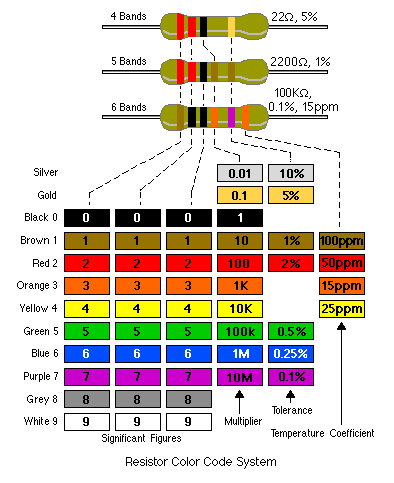
Had to obtain 6 different resistors of different resistant values and calculate the value of each resistor by using a colour code chart using the maximum and minimum tolerance of each resistor, then measure each resistor value with our multimeters.

Results to experiment..


I then chose 2 resistors and then recorded there individual ohm resistances which i measured with my multi meter.

Resistor 1.. 990 ohm's

Resistor 2.. 2117 ohm's

Then we were required to connect the 2 resistors in series (joint end on end) and had to calculate the value in series (3107 ohm's) and then the actual test reading through a multimeter (3166 ohm's)

Next we had to connect them in parallel (both ends when they are side to side, end joint to end, almost joint like a circle) the calculated value was (3107 ohm's) and then again the measured recording through a multimeter was (.679 ohm's)

This experiment showed that the resistance when tested in series was added together to give you a joint resistance, where as when you test them in parallel you divide up the resistance because there is now 2 paths for the electricity to flow.